Release: llm-gemini 0.37
Google launched Gemini 4 Hydrogen today - the lowest cost member of the Gemini 4 family.
It's actually not too far off the price of its much bigger siblings, Carbon and Argon. I'm finding Gemini 4's pricing really confusing. Here's the pricing scheme:
| Gemini 4 Carbon | Through Nov 30, 2026 | $2.00 | $0.10 | $10.00 |
| From Dec 1, 2026 | $4.00 | $0.20 | $20.00 | |
| Gemini 4 Argon | Through Nov 30, 2026 | $2.00 | $0.10 | $10.00 |
| From Dec 1, 2026 | $4.00 | $0.20 | $20.00 | |
| Gemini 4 Hydrogen | $1.50 | $0.075 | $7.50 |
Carbon and Argon are the same price, and both are scheduled to double in price on December 1st. If they're the same price, why have two different models? Google says that Argon "delivers Gemini 4 intelligence with faster responses and lower token spend per turn compared to Gemini 4 Carbon" - so it may be priced the same, but it will use less tokens per task.
Hydrogen, supposedly the cheap model, is currently only a 25% discount on its more capable piers. The Hydrogen price will make more sense after December 1st, when it will represent a 75% discount. It's still considerably more expensive than Claude Haiku 5.5 and GPT-6 Luna - they're both $0.10/$0.50, so Hydrogen is 15x that.
I had Hydrogen generate some pelicans. Here's a full comparison grid showing the pelicans for all three members of the Gemini 4 family at their three supported effort levels:
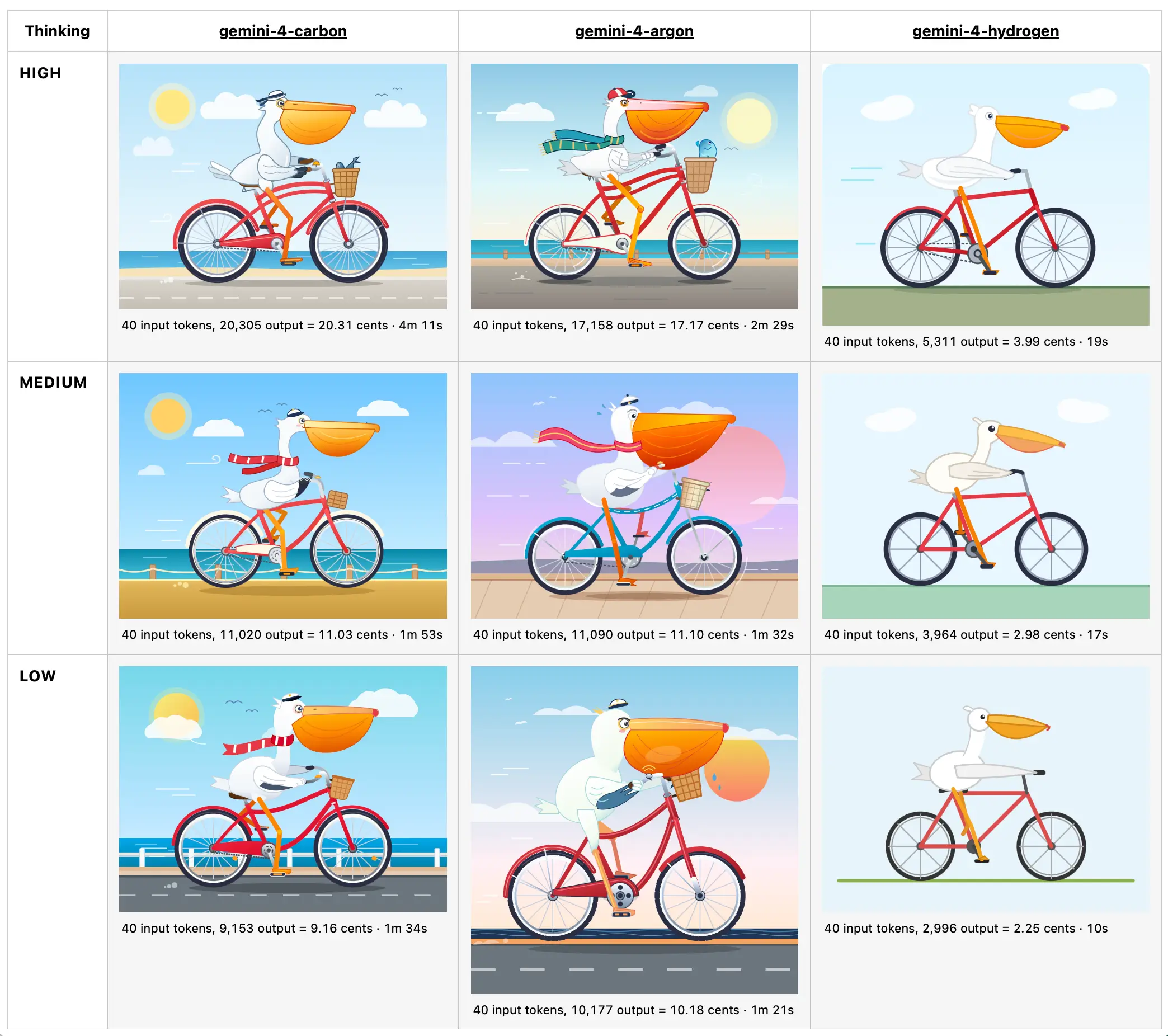
Considering how close they are in price, the difference in pelican quality for Hydrogen is quite stark.
Here's how Google describe Hydrogen's intended position in their mix of models:
In real-world software development, while teams rely on frontier models like Carbon and Argon for deep architectural judgment when designing systems or untangling subtle bugs, they still need a fast, disciplined execution model for writing code, running tests, and verifying changes. Hydrogen is built to stand on its own as a model for everyday work — or to pair with Carbon and Argon as the high-efficiency execution engine in multi-model workflows.
Most notably, Hydrogen is the new free tier model, and is the model that will power AI features in Google Search.